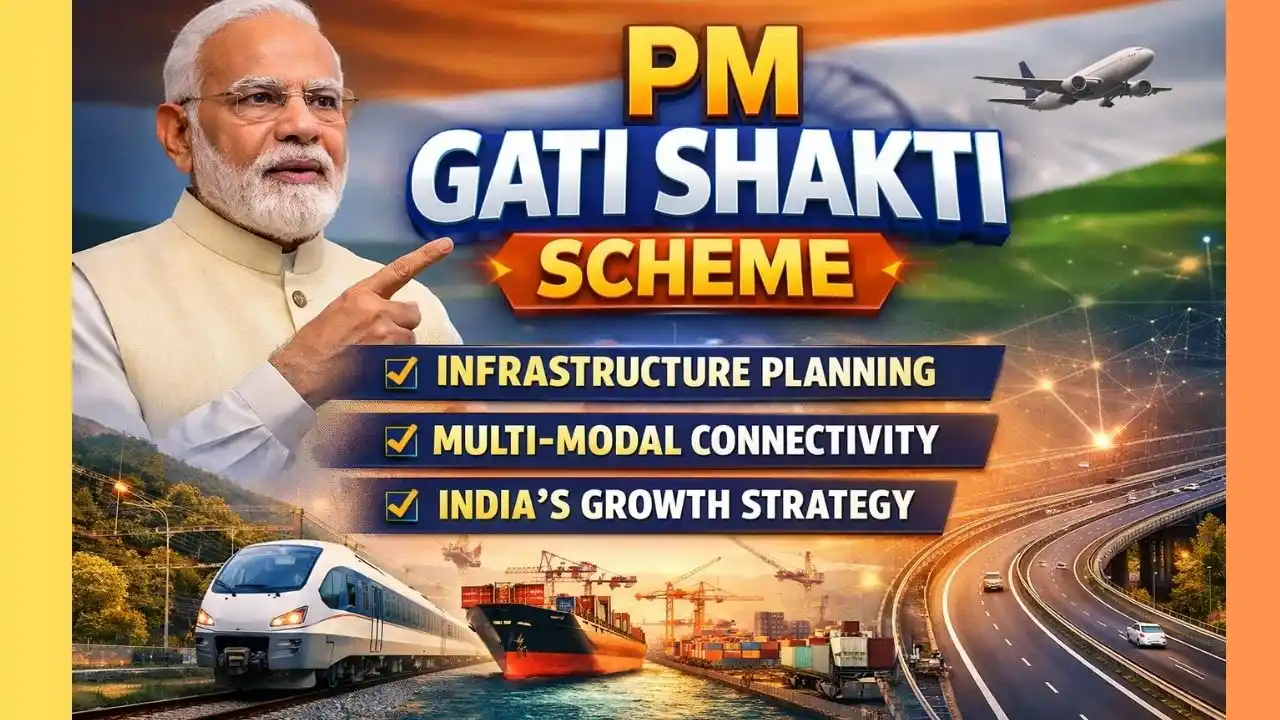
PM Gati Shakti Scheme 2026: Objectives, Features, Implementation, and Importance
India’s development trajectory has always depended on two fundamentals: economic reform and infrastructure creation. Over the past decade, the country has invested heavily in highways, railways, ports, airports, power grids, and digital networks. Yet one problem kept resurfacing. These assets were often planned and executed in isolation. Roads ended without rail connectivity. Industrial zones lacked port access. Logistics hubs were built without last-mile integration.
The PM Gati Shakti Scheme was designed to solve this exact problem.
Rather than announcing another spending-heavy infrastructure program, the government introduced a planning reform. PM Gati Shakti reframed how infrastructure projects are conceived, coordinated, and implemented across India. It is less about building more assets and more about building them smarter, together, and on time.
This article explains what PM Gati Shakti is, why it was launched, how it works, where it stands in 2026, and why it matters for governance, the economy, and civil services preparation.
What Is the PM Gati Shakti Scheme?
PM Gati Shakti is a National Master Plan for Multi-Modal Connectivity. It is not a beneficiary-based welfare scheme. No applications. No direct cash transfers. Instead, it is a strategic planning framework that integrates infrastructure development across multiple sectors and ministries.
India’s infrastructure ecosystem includes roads, railways, ports, airports, inland waterways, logistics parks, industrial corridors, power lines, telecom networks, and urban infrastructure. Earlier, each of these sectors planned projects independently. PM Gati Shakti brings all of them onto a single digital platform.
This platform uses geospatial data and real-time project information to allow ministries, state governments, and agencies to plan infrastructure in alignment with each other. Every new project is visualized on a shared map before approval. Conflicts are identified early. Gaps in connectivity are addressed at the planning stage, not after construction.
In simple terms, PM Gati Shakti acts as a digital command center for India’s physical infrastructure.
PM Gati Shakti Scheme Details
| Aspect | Key Details |
|---|---|
| Scheme Name | PM Gati Shakti Scheme |
| Type | National Master Plan for Multi-Modal Connectivity |
| Launched By | Government of India |
| Announcement Date | 15 August 2021 |
| Launch Date | 13 October 2021 |
| Nodal Agency | Department for Promotion of Industry and Internal Trade (DPIIT) |
| Concerned Ministry | Ministry of Commerce and Industry |
| Nature of Scheme | Infrastructure planning and coordination framework |
| Coverage | Roads, Railways, Ports, Airports, Waterways, Power, Telecom, Logistics |
| Core Objective | Integrated and synchronized infrastructure planning |
| Key Feature | GIS-based digital platform with real-time data |
| Beneficiary | Government agencies, states, infrastructure planners, economy |
| Direct Public Benefit | No direct cash or registration-based benefit |
| Governance Approach | Whole-of-government and cooperative federalism |
| District Focus | District Master Plans under Gati Shakti |
| Economic Impact | Reduced logistics cost, faster project execution |
| UPSC Relevance | Prelims, GS Paper 2 and GS Paper 3 |
Why PM Gati Shakti Was Needed
India’s logistics costs have traditionally remained high compared to global benchmarks. Delays in freight movement, inefficient routing, multiple handling points, and lack of coordination between transport modes increased costs for businesses and reduced competitiveness.
The underlying causes were structural:
- Ministries planned projects in silos
- States lacked visibility into central infrastructure plans
- Clearances were sequential instead of parallel
- Data sharing between agencies was limited
- Last-mile connectivity was often an afterthought
The result was delayed projects, cost overruns, and underutilized assets.
PM Gati Shakti was introduced to break this pattern.
The vision was clear: infrastructure planning must shift from fragmented execution to integrated strategy. Roads must connect to railheads. Rail lines must link to ports. Industrial zones must align with logistics hubs. Digital infrastructure must follow physical infrastructure.
This whole-of-government approach marked a departure from earlier models.
Launch and Vision Behind PM Gati Shakti
The initiative was announced on 15 August 2021 and formally launched on 13 October 2021 after cabinet approval.
The government positioned PM Gati Shakti as a foundational reform that would support long-term national goals, including:
- Reducing logistics costs
- Improving ease of doing business
- Strengthening domestic manufacturing
- Enhancing export competitiveness
- Accelerating project execution
- Promoting balanced regional development
- Creating employment through infrastructure investment
The scheme also aligned with broader national missions such as Make in India, Atmanirbhar Bharat, and long-term development goals leading up to 2047.
How PM Gati Shakti Works: The Institutional Framework
PM Gati Shakti operates through a digital National Master Plan platform supported by institutional coordination mechanisms.
1. Integrated Digital Platform
At the heart of the scheme is a GIS-based platform that hosts thousands of data layers, including:
- Existing infrastructure assets
- Ongoing and proposed projects
- Land use patterns
- Environmental and forest boundaries
- Utility networks
- Social infrastructure
Every participating ministry and state uploads its data onto this shared system. When a new project is proposed, planners can see how it interacts with existing and future infrastructure across sectors.
This eliminates blind planning.
2. Inter-Ministerial Coordination
The platform integrates data from dozens of central ministries and all states and union territories. This ensures that infrastructure planning is no longer confined to departmental boundaries.
Projects are reviewed collectively, enabling faster approvals and better alignment.
3. District-Level Planning
One of the most important expansions under PM Gati Shakti has been the introduction of District Master Plans. These plans bring the same integrated planning approach to the local level, ensuring that district infrastructure aligns with state and national networks.
This strengthens grassroots implementation and cooperative federalism.
Which Ministry Implements PM Gati Shakti?
PM Gati Shakti does not belong to a single executing ministry in the traditional sense. It is a cross-government initiative.
The Department for Promotion of Industry and Internal Trade (DPIIT) under the Ministry of Commerce and Industry acts as the nodal agency. DPIIT is responsible for coordination, platform management, and overall policy oversight.
However, implementation depends on multiple infrastructure-building ministries, including:
- Railways
- Road Transport and Highways
- Ports, Shipping and Waterways
- Civil Aviation
- Power
- Petroleum and Natural Gas
- Telecommunications
- Urban and rural development departments
The strength of PM Gati Shakti lies in this shared ownership.
PM Gati Shakti in 2026: Current Status and Progress
By 2026, PM Gati Shakti has moved beyond the pilot phase. It is now an operational planning framework influencing real investment decisions.
Key developments include:
Wide Institutional Coverage
- Dozens of central ministries and all states and union territories are onboarded
- Thousands of infrastructure projects are mapped on the platform
- Data integration has expanded year after year
Project Optimization
- Identification of logistics bottlenecks
- Better routing of freight corridors
- Improved alignment between industrial zones and transport infrastructure
Private Sector Participation
- Selected geospatial data is being opened to private stakeholders
- Logistics companies and developers can plan investments with greater clarity
Governance Evolution
- Earlier coordination bodies are being restructured into stronger centralized planning mechanisms
- Decision-making is becoming faster and more outcome-oriented
Most importantly, PM Gati Shakti is no longer just a policy concept. It is shaping on-ground infrastructure outcomes.
Key Achievements of PM Gati Shakti
Some of the measurable impacts observed so far include:
- Faster project approvals due to parallel clearances
- Reduction in planning conflicts between ministries
- Improved last-mile connectivity
- Better utilization of existing assets
- Enhanced transparency in infrastructure planning
While challenges remain, the shift in planning culture is evident.
Importance of PM Gati Shakti for the Indian Economy
Infrastructure is not just concrete and steel. It determines how efficiently an economy functions.
PM Gati Shakti contributes to economic growth by:
- Lowering logistics costs for manufacturers and exporters
- Improving supply chain reliability
- Encouraging private investment
- Supporting industrial corridors and clusters
- Creating jobs through infrastructure construction and allied sectors
In the long run, integrated planning also supports sustainability by reducing redundant construction and optimizing resource use.
PM Gati Shakti and Cooperative Federalism
A notable feature of the scheme is its emphasis on cooperative planning.
States are not passive recipients. They are active contributors of data and partners in decision-making. District-level integration further strengthens this model.
This approach respects India’s federal structure while ensuring national coherence.
Relevance of PM Gati Shakti for UPSC and Civil Services Exams
PM Gati Shakti is a high-value topic for civil services preparation.
Prelims
- National Master Plan
- Multi-modal connectivity
- Nodal ministry
- Launch year and objectives
Mains (GS Paper 2 and 3)
- Governance reforms
- Inter-ministerial coordination
- Infrastructure and economic development
- Use of technology in administration
- Federalism and decentralization
Interview
- Real-world application of policy integration
- Challenges in implementation
- Long-term impact on India’s growth
Aspirants should focus on both conceptual clarity and practical outcomes.
Challenges and Limitations
Despite its strengths, PM Gati Shakti faces certain challenges:
- Data accuracy and timely updates
- Capacity gaps at the district level
- Inter-departmental resistance to change
- Cybersecurity and data governance concerns
Addressing these issues will determine how effectively the platform delivers results.
The Road Ahead: What to Expect Beyond 2026
Looking forward, PM Gati Shakti is expected to deepen in four key areas:
- Stronger District Integration
Local planning will become more data-driven and aligned with national goals. - Expanded Private Sector Use
Businesses will increasingly rely on the platform for logistics and investment planning. - Governance Refinement
Institutional mechanisms will evolve to improve accountability and speed. - Focus on Last-Mile Gaps
Rural and urban connectivity gaps will receive greater attention.
The emphasis will shift from onboarding to optimization.
PM Gati Shakti Scheme F.A.Q.
– What is the PM Gati Shakti Scheme?
PM Gati Shakti is a National Master Plan for Multi-Modal Connectivity aimed at coordinating infrastructure planning across sectors such as roads, railways, ports, airports, waterways, power, and telecom. It focuses on integrated planning using a digital, GIS-based platform rather than providing direct benefits to individuals.
– Which ministry is responsible for implementing PM Gati Shakti?
The Department for Promotion of Industry and Internal Trade (DPIIT), under the Ministry of Commerce and Industry, is the nodal agency for PM Gati Shakti. However, multiple infrastructure-related ministries and state governments participate in planning and execution.
– What are the main objectives of the PM Gati Shakti Scheme?
The key objectives include reducing logistics costs, improving multi-modal connectivity, speeding up infrastructure project execution, eliminating inter-ministerial planning silos, supporting manufacturing and trade, and promoting balanced regional development.
– How does PM Gati Shakti help the Indian economy?
By improving coordination and reducing delays in infrastructure projects, PM Gati Shakti lowers logistics costs, enhances supply chain efficiency, attracts private investment, strengthens export competitiveness, and supports long-term economic growth.
– Why is PM Gati Shakti important for UPSC and other civil services exams?
PM Gati Shakti is important for civil services exams because it links governance reforms, infrastructure development, technology use in administration, cooperative federalism, and economic growth. It is relevant for Prelims, Mains (GS Paper 2 and 3), and interview discussions.
Conclusion
PM Gati Shakti is not a conventional infrastructure scheme. It is a planning reform with long-term implications.
By replacing fragmented decision-making with integrated strategy, it addresses one of India’s most persistent development bottlenecks. Roads, railways, ports, power, and digital networks are no longer viewed as separate projects but as parts of a single system.
For citizens, this means better connectivity and smoother movement of goods.
For businesses, it means lower costs and predictability.
For administrators, it means data-driven governance.
For students and aspirants, it offers a textbook example of modern policy design.
Also read:-