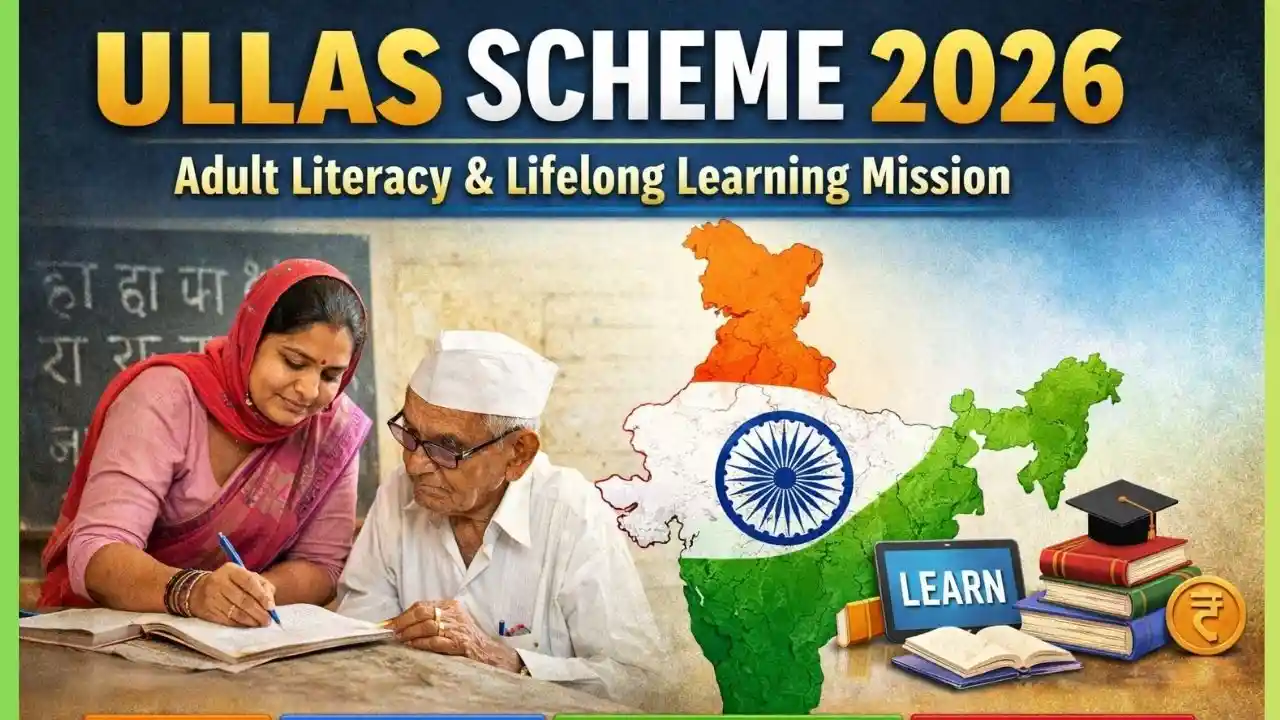
ULLAS Scheme 2026: Full Form, Objectives, Benefits, Eligibility, States List & Latest Updates
Education does not stop at childhood. In a country as large and diverse as India, millions of adults missed the opportunity to complete formal schooling due to poverty, social barriers, migration, or lack of access. The ULLAS Scheme was created to address exactly this gap. It recognizes a simple truth: learning is lifelong, and literacy today means far more than reading and writing.
ULLAS stands for Understanding of Lifelong Learning for All in Society. It is a national initiative by the Government of India that focuses on adult education in a comprehensive and practical way. Instead of limiting itself to basic literacy, the scheme aims to equip adults with essential skills needed to function confidently in modern society. These include digital literacy, financial awareness, vocational skills, and continuous learning opportunities.
Aligned with the National Education Policy 2020, ULLAS represents a shift in how India views education. It treats learning as a continuous process that should be accessible to everyone, regardless of age, background, or location. Through community participation, volunteer support, and technology-enabled learning, the scheme seeks to build an inclusive, skilled, and empowered society.

What Is the ULLAS Scheme?
The ULLAS Scheme is a centrally sponsored adult education programme designed to provide functional literacy and lifelong learning opportunities to individuals aged 15 years and above. It goes beyond traditional definitions of literacy by combining basic education with life-oriented skills that directly improve quality of life.
At its core, ULLAS focuses on five major learning components:
- Foundational literacy and numeracy
- Critical life skills such as health awareness, legal knowledge, and civic responsibility
- Digital literacy and financial literacy
- Vocational skills and employability-focused learning
- Continuing education for personal and professional growth
The scheme is implemented under the broader framework of the New India Literacy Programme (NILP). Its goal is not only to reduce illiteracy numbers but also to ensure that learners can apply their knowledge in real-world situations.
ULLAS treats adult learners with respect. The curriculum is flexible, practical, and tailored to daily needs. Learning can take place in classrooms, community centers, homes, or digital platforms, depending on local conditions. This adaptability is one of the scheme’s strongest features.
ULLAS Scheme Details
| Particular | Details |
|---|---|
| Scheme Name | ULLAS Scheme |
| Full Form | Understanding of Lifelong Learning for All in Society |
| Launched By | Government of India |
| Implementing Ministry | Ministry of Education |
| Launch Year | 2022 |
| Scheme Type | Centrally Sponsored Scheme |
| Official Programme | New India Literacy Programme (NILP) |
| Objective | Adult literacy, life skills, digital & financial education |
| Target Beneficiaries | Adults aged 15 years and above |
| Coverage | All States and Union Territories of India |
| Learning Focus Areas | Literacy, numeracy, life skills, vocational skills, continuing education |
| Mode of Learning | Online and Offline |
| Key Support System | Community participation and volunteer educators |
| Time Period | 2022–23 to 2026–27 |
| Literacy Benchmark | 95% adult literacy rate |
| First Fully Literate State | Mizoram |
| First Fully Literate UT | Ladakh |
| Cost to Beneficiaries | Free |
| Policy Alignment | National Education Policy 2020 |
| Long-Term Goal | Universal functional literacy and lifelong learning |
Full Form of ULLAS Scheme
The full form of ULLAS is:
Understanding of Lifelong Learning for All in Society
This name reflects the philosophy behind the programme. Literacy is not seen as a one-time milestone but as a continuous ability to learn, adapt, and participate meaningfully in society. The emphasis on lifelong learning acknowledges that skills must evolve with changing economic, technological, and social realities.
ULLAS promotes the idea that education empowers individuals not just economically, but socially and culturally as well. It encourages curiosity, self-reliance, and informed decision-making at every stage of life.
Who Launched the ULLAS Scheme and Why?
The ULLAS Scheme was launched by the Government of India under the Ministry of Education. It officially began in April 2022 as part of the New India Literacy Programme.
The launch was guided by the vision of the National Education Policy 2020, which called for a broader and more inclusive definition of literacy. NEP 2020 recognized that in the modern world, adults need more than basic reading and writing skills. They need digital competence, financial understanding, problem-solving ability, and awareness of their rights and responsibilities.
India has historically faced challenges with adult illiteracy. Despite progress in school education, a large section of the adult population lacked access to structured learning. ULLAS was designed to bridge this gap by bringing education directly into communities and using local resources effectively.
Another key reason for launching ULLAS was to leverage technology and volunteerism. Instead of relying solely on formal institutions, the scheme encourages participation from teachers, students, NGOs, community leaders, and civil society members.
Core Objectives of the ULLAS Scheme
The ULLAS Scheme has clearly defined objectives that focus on both literacy and empowerment. These include:
- Achieving universal functional literacy among adults aged 15 and above
- Promoting digital and financial literacy for everyday life
- Enhancing employability through vocational skills
- Encouraging lifelong learning habits
- Strengthening community participation in education
By addressing literacy in a holistic way, the scheme aims to create confident, informed, and skilled citizens who can actively contribute to national development.
Community Involvement and Volunteerism in ULLAS
One of the most distinctive features of the ULLAS Scheme is its reliance on community participation. Education is not treated as a top-down process. Instead, it becomes a shared responsibility.
Volunteers play a central role in the implementation of ULLAS. These volunteers come from schools, colleges, universities, self-help groups, retired professionals, and social organizations. They act as teachers, mentors, and guides for adult learners.
This model has several advantages:
- It builds trust between learners and educators
- It reduces dependence on formal infrastructure
- It ensures learning is culturally and locally relevant
Volunteer-driven education also creates a sense of ownership within communities. Literacy becomes a collective goal rather than an imposed target.
Digital and Offline Learning Under the ULLAS Scheme
ULLAS adopts a blended learning approach. Learners can access educational content through digital platforms as well as offline modes.
Digital learning is supported through government-backed platforms that provide structured content in multiple Indian languages. This helps learners develop basic digital skills while accessing educational material.
At the same time, offline learning ensures inclusion for regions with limited internet access. Community learning centers, schools, and local institutions are used to conduct classes, discussions, and assessments.
This dual approach ensures that no learner is excluded due to geography, language, or technology barriers.
Which States Are Covered by the ULLAS Scheme?
The ULLAS Scheme is implemented across all states and Union Territories of India. It is a nationwide programme with uniform objectives but flexible execution to suit local needs.
Adult learners from both rural and urban areas are eligible to participate. State governments and local administrations play a key role in identifying learners, mobilizing volunteers, and monitoring progress.
Since its launch, several states and UTs have shown remarkable progress, demonstrating how effective implementation can lead to rapid improvements in literacy outcomes.
ULLAS Scheme Achievements Across States
Some states and Union Territories have achieved major milestones under the ULLAS Scheme by crossing the 95 percent adult literacy benchmark, which is considered the threshold for full literacy.
Notable achievements include:
- Mizoram became the first state to achieve full literacy under ULLAS
- Goa followed as the second fully literate state
- Tripura became the third state to cross the benchmark
- Himachal Pradesh also achieved full literacy status
- Ladakh, a Union Territory, reached full functional literacy earlier in 2024
These achievements highlight the effectiveness of the ULLAS model when supported by strong governance and community involvement.
ULLAS Scheme Ranking and Leading Regions
The concept of ranking under the ULLAS Scheme is linked to the order in which states and UTs achieve full literacy status. The benchmark used is a 95 percent literacy rate among adults aged 15 and above.
Based on this criterion:
- Mizoram holds the first position
- Goa ranks second
- Tripura ranks third
- Himachal Pradesh follows closely
- Ladakh stands out as the first UT to achieve the target
These rankings are symbolic but important. They encourage healthy competition among states and highlight best practices that others can replicate.
Which State Was First to Achieve Full Literacy Under ULLAS?
Mizoram was the first state in India to be declared fully literate under the ULLAS Scheme. It achieved a literacy rate of approximately 98.2 percent, well above the national benchmark.
This achievement is significant for several reasons. It demonstrates the power of community-driven education, effective volunteer mobilization, and consistent policy implementation.
Mizoram’s success has become a reference point for other states aiming to achieve similar outcomes under the scheme.
Time Period of the ULLAS Scheme
The ULLAS Scheme is planned as a five-year mission. It is being implemented from financial year 2022–23 to 2026–27.
During this period, the programme aims to reach millions of adult learners and provide them with essential skills for daily life and employment. The timeline also aligns with national and international education goals, including the Sustainable Development Goal 4, which focuses on quality education for all.
The five-year structure allows for phased implementation, monitoring, and improvement based on feedback and outcomes.
ULLAS Scheme PDF and Official Documents
The government has released detailed guidelines and framework documents for the ULLAS Scheme under the New India Literacy Programme. These documents explain:
- Scheme objectives and components
- Target beneficiaries
- Curriculum structure
- Assessment methods
- Roles of states and volunteers
These official documents serve as the foundation for implementation and help ensure consistency across regions while allowing flexibility where needed.
Role of Press Information Bureau in ULLAS Updates
The Press Information Bureau (PIB) regularly publishes official updates related to the ULLAS Scheme. These updates confirm achievements, participation levels, and policy direction.
PIB releases have highlighted milestones such as Ladakh achieving full literacy and the growing number of learners and volunteers enrolled in the programme. These updates provide transparency and reinforce the government’s commitment to adult education.
ULLAS Scheme F.A.Q.
– Who is eligible to benefit from the ULLAS Scheme?
Any individual aged 15 years or above who has not completed formal schooling or lacks basic literacy and life skills is eligible. The scheme is open to learners from both rural and urban areas across all states and Union Territories.
– Is the ULLAS Scheme limited to reading and writing skills?
No. ULLAS goes far beyond basic literacy. It includes numeracy, digital and financial literacy, vocational skills, critical life skills, and opportunities for continuing education so learners can function confidently in everyday life.
– Is there any fee to enroll in the ULLAS Scheme?
No. The ULLAS Scheme is fully government-funded. Learners do not have to pay any fees to participate in classes, access learning material, or take assessments.
– How are classes conducted under the ULLAS Scheme?
Learning is offered through a mix of offline and digital modes. Classes may be held in schools, community centers, or local institutions, while digital content is provided through government platforms to support flexible learning.
– What is considered “full literacy” under the ULLAS Scheme?
A state or Union Territory is considered fully literate when at least 95 percent of its population aged 15 years and above achieves functional literacy as defined by the scheme’s standards.
Conclusion: Why the ULLAS Scheme Matters
The ULLAS Scheme is not just an education programme. It is a national movement that redefines what literacy means in modern India. By combining basic education with life skills, digital awareness, and community participation, it addresses the real needs of adult learners.
States like Mizoram, Goa, Tripura, Himachal Pradesh, and Ladakh have shown that full literacy is achievable with the right approach. The five-year mission may end in 2027, but its impact will extend far beyond that timeline.
ULLAS proves that learning has no age limit. When education is inclusive, flexible, and rooted in community effort, it becomes a powerful tool for social and economic transformation.
Also read:-