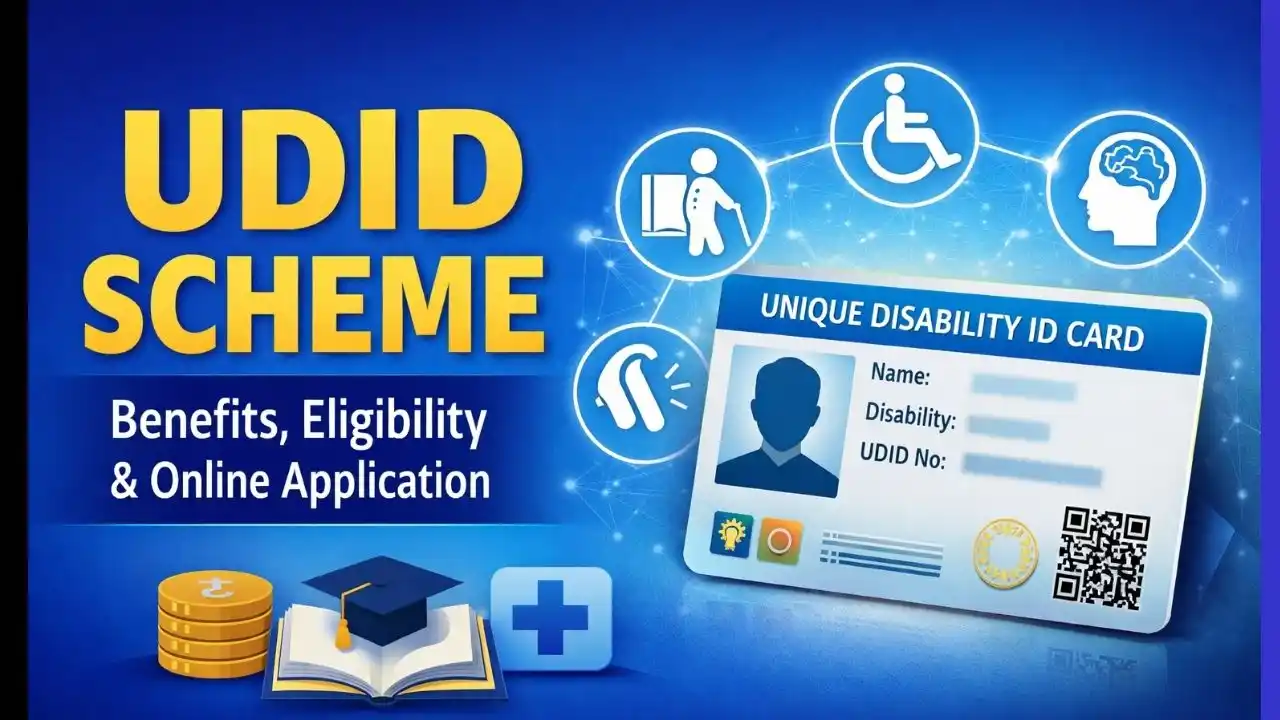
UDID Scheme: Complete Guide to Purpose, Benefits, Eligibility, and Online Application Process
Government welfare schemes only work when they reach the people they are meant for. For millions of persons with disabilities in India, access to benefits used to be slow, confusing, and paperwork-heavy. Different certificates, different formats, repeated verification, and long delays made an already difficult life harder.
The Unique Disability ID Scheme, commonly known as the UDID Scheme, was created to fix this gap. It brings structure, transparency, and dignity into the disability certification system. More importantly, it gives persons with disabilities a single, recognized identity that connects them to welfare schemes across the country.
This guide explains what the UDID scheme is, why it exists, who can apply, how the online application works, and how it helps in real life. No jargon. No shortcuts. Just what you need to know.

What Is the UDID Scheme?
UDID stands for Unique Disability ID. It is a nationwide initiative launched by the Government of India through the Department of Empowerment of Persons with Disabilities.
The scheme creates a centralized digital identity for persons with disabilities. Every eligible individual is issued a UDID number and card that serves as official proof of disability anywhere in India.
Before UDID, disability certificates were issued by states in different formats. Records were scattered. Verification was slow. Migrating from one state to another often meant starting from scratch. UDID changed that system.
Under this scheme, all disability records are stored in a single national database. The UDID card contains verified details such as:
- Personal information
- Type of disability
- Percentage of disability
- Validity of the certificate
Once issued, this card becomes the primary document for accessing disability-related benefits, services, and concessions.
Think of UDID as a permanent, trusted identity for disability recognition across departments and states.
UDID Scheme Details
| Topic | Details |
|---|---|
| Scheme Name | Unique Disability ID (UDID) Scheme |
| Launched By | Government of India |
| Implementing Authority | Department of Empowerment of Persons with Disabilities |
| Launch Year | 2016 |
| Purpose | To provide a unique, centralized digital identity to persons with disabilities |
| Target Beneficiaries | Persons with disabilities (PwDs) in India |
| Minimum Disability Requirement | 40% disability or more |
| Total Disability Categories Covered | 21 types of disabilities |
| UDID Card Validity | Permanent or temporary, depending on disability type |
| Application Mode | Online |
| Application Cost | Free of cost |
| Medical Assessment | Mandatory through authorized medical board (if required) |
| Documents Required | Identity proof, address proof, photograph, medical records |
| Certificate Format | Digital disability certificate with UDID number |
| National Validity | Valid across all states and union territories |
| Main Benefits | Easy access to welfare schemes, reduced paperwork, nationwide recognition |
| Linked Welfare Schemes | Scholarships, pensions, health benefits, employment reservations |
| Pension Benefit | UDID itself is not a pension but helps access disability pensions |
| Status Tracking | Available through online portal |
| Renewal Facility | Yes, for temporary disability certificates |
| Replacement Option | Available if UDID card is lost or damaged |
| Mandatory Usage | Required for availing benefits under multiple government schemes |
| Objective Outcome | Transparency, fraud reduction, efficient service delivery |
Why the UDID Scheme Matters
Here’s what matters most: recognition leads to access.
Without a valid and accepted disability certificate, people are often excluded from schemes meant specifically for them. The UDID scheme ensures that eligible individuals are officially recognized, recorded, and supported.
It also shifts disability certification from a paper-based system to a digital one. That change alone reduces delays, duplication, and misuse.
For the government, UDID brings clean data and better policy implementation.
For citizens, it brings clarity, speed, and dignity.
Objectives of the UDID Scheme
The scheme was designed with clear goals in mind.
1. Create a National Disability Database
UDID builds a single, verified database of persons with disabilities across India. This helps government departments coordinate better and avoid duplicate or fake records.
2. Standardize Disability Certification
Instead of multiple formats and rules across states, UDID creates a uniform certification process that is accepted nationwide.
3. Improve Access to Welfare Schemes
Once a person has a UDID card, they can access various central and state government schemes without repeated verification.
4. Enable Digital and Transparent Services
Applications, renewals, corrections, and tracking can all be done online. This reduces physical visits and middlemen.
5. Support Better Policy Planning
Accurate data helps the government understand how many people need what kind of support, and where gaps exist.
The broader goal is simple: make disability welfare efficient, fair, and reachable.
Key Benefits of the UDID Scheme
A UDID card offers practical, everyday advantages.
1. Nationwide Valid Disability Identity
The UDID card is accepted across India as valid proof of disability. There’s no need to obtain separate certificates for different states or departments.
2. Easier Access to Government Schemes
Many welfare schemes now require a UDID number. These include scholarships, pensions, insurance benefits, skill training programs, and employment reservations.
3. Reduced Documentation Burden
Once your details are verified and stored digitally, you don’t need to submit disability certificates repeatedly for each scheme.
4. Online Tracking and Updates
Applicants can track application status, update personal details, or request corrections through the portal.
5. Protection Against Misuse
Digital verification reduces fake certificates and ensures benefits reach genuine beneficiaries.
6. Long-Term Convenience
A permanent ID saves time and effort year after year, especially for renewals or migration to another state.
For many families, this single card removes years of administrative struggle.
Who Can Apply Under the UDID Scheme?
The UDID scheme is meant for persons with disabilities as defined under Indian law.
Recognized Disabilities
Currently, the scheme covers 21 categories of disabilities, including:
- Physical disabilities
- Visual impairment
- Hearing impairment
- Speech and language disability
- Intellectual disability
- Mental illness
- Autism spectrum disorder
- Cerebral palsy
- Multiple disabilities
Minimum Disability Requirement
To be eligible, the applicant must have at least 40 percent disability, as certified by a medical authority.
Basic Requirements
- Indian citizenship
- Valid identity proof
- Address proof
- Medical assessment by an authorized board
Both new applicants and those with existing disability certificates can apply.
UDID Scheme for Disabled Persons: Ground Reality
On paper, the UDID system is strong. On the ground, progress varies by region.
Some states process applications quickly. Others face delays due to limited medical boards or high application volume. Rural applicants may face challenges related to hospital visits and documentation.
Despite these gaps, UDID has significantly improved access compared to the earlier system. Once issued, the benefits far outweigh the initial effort.
Awareness remains a key challenge. Many eligible individuals still don’t know that a centralized ID exists or that older certificates may not be enough anymore.
How to Apply for the UDID Scheme Online
The online application process is designed to be simple and traceable.
Step 1: Online Registration
Applicants must register using basic personal details such as name, date of birth, contact number, and identity information.
Step 2: Fill the Application Form
The form requires:
- Personal details
- Disability details
- Type and duration of disability
- Existing disability certificate details, if available
Step 3: Upload Required Documents
Commonly required documents include:
- Identity proof
- Address proof
- Photograph
- Existing medical records or certificates
Step 4: Submit the Application
After submission, an application number is generated. This number is crucial for tracking progress.
Step 5: Medical Board Assessment
If required, the applicant is called for assessment by a designated medical board. This step confirms the disability type and percentage.
Step 6: Approval and Issuance
Once verified, the UDID card and digital disability certificate are issued. These can be downloaded and used immediately.
The entire process reduces physical visits and keeps the applicant informed at every stage.
Documents Required for UDID Application
While exact requirements may vary slightly, most applicants need:
- Aadhaar or other identity proof
- Address proof
- Passport-size photograph
- Medical reports related to disability
- Existing disability certificate, if any
Keeping documents clear and updated helps avoid delays.
UDID Card Validity and Renewal
Some disability certificates are permanent, while others have a validity period depending on the nature of disability.
For temporary or progressive conditions, renewal may be required. The UDID portal allows users to apply for renewal online without starting the process again from scratch.
UDID Scheme and Pension Benefits
There is often confusion around the term “UDID pension.”
Here’s the clear answer.
The UDID scheme itself does not provide a pension.
However, many central and state disability pension schemes require a UDID card as proof of eligibility. Once you have a UDID number, applying for these pensions becomes easier.
States decide:
- Pension amount
- Income limits
- Age criteria
In several regions, having a UDID card speeds up approval and reduces verification hurdles.
So while UDID is not a pension, it acts as the key that unlocks pension benefits.
Mandatory Use of UDID for Welfare Schemes
A major policy shift made the UDID number mandatory for accessing benefits under multiple government schemes for persons with disabilities.
This move aims to:
- Prevent duplication
- Improve targeting
- Ensure accountability
For individuals with older disability certificates, linking or updating to UDID has become essential.
Challenges in UDID Implementation
No system is perfect.
Some common challenges include:
- Delays in medical board appointments
- Lack of awareness in rural areas
- Technical issues on the portal
- Staff shortages in hospitals
Despite this, the long-term benefits of having a permanent digital identity make the effort worthwhile.
UDID Scheme Launch and Evolution
The UDID project was launched in 2016. Since then, it has expanded from a basic ID system into a core requirement for disability welfare administration.
Over the years, the focus has shifted toward full digitization, integration with other schemes, and mandatory adoption.
This evolution signals a long-term commitment to structured disability support in India.
Conclusion
The UDID Scheme gives persons with disabilities a single, trusted identity recognized across India. It simplifies certification, improves access to welfare schemes, and reduces the burden of repeated verification.
It is not just an ID card. It is a gateway. If you are eligible, applying for UDID is no longer optional. It is essential for accessing present and future benefits.
For families, caregivers, and individuals, understanding and using the UDID system can make a real difference in education, healthcare, income support, and overall quality of life.
The system still has gaps, but the direction is right. And for millions of people, this one card brings order, access, and dignity where there was confusion before.
Also read:-