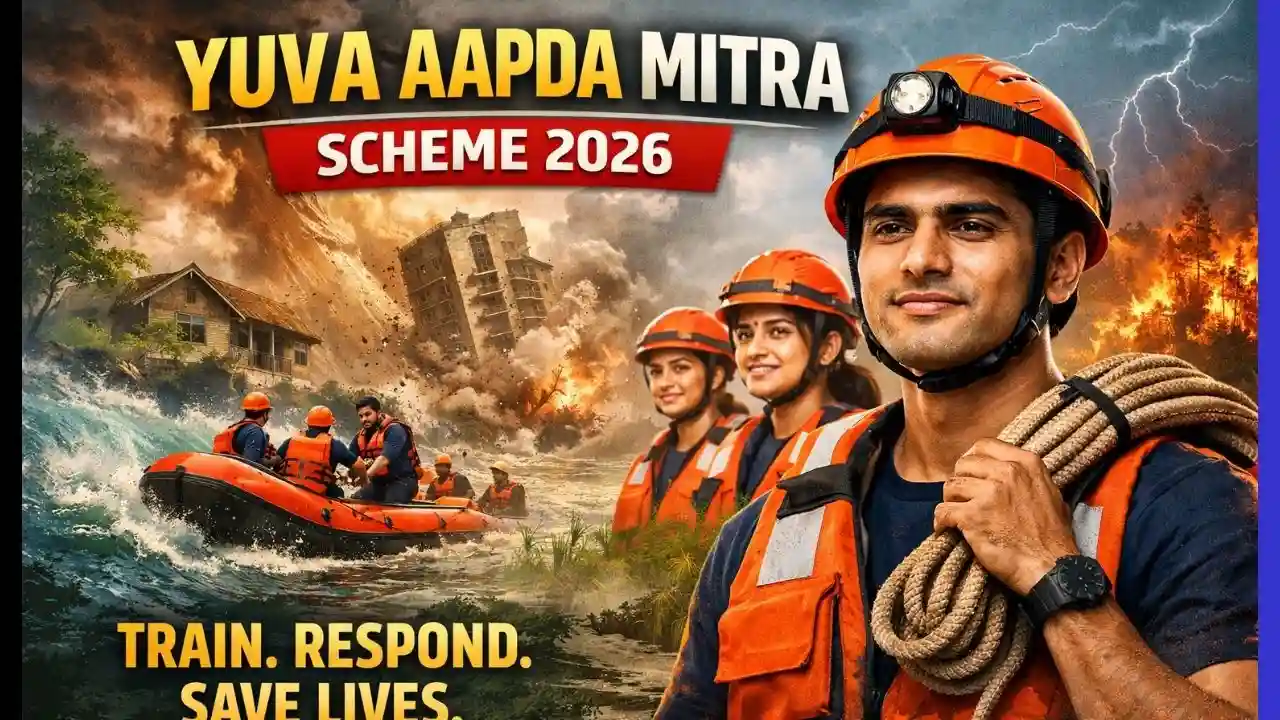
Yuva Aapda Mitra Scheme 2026: Complete Guide to Training, Benefits, Eligibility, and Registration
Natural disasters do not wait for permission. Floods arrive overnight. Earthquakes strike without warning. Landslides, cyclones, fires, and cloudbursts leave behind loss that takes years to recover from. India knows this reality well. Every year, multiple states face emergencies that overwhelm local systems and test community resilience.
This is where disaster preparedness stops being a policy document and starts becoming a people’s movement. The Yuva Aapda Mitra Scheme stands at the center of that shift. It focuses on one powerful idea: trained youth can save lives before professional help even arrives.
Let me explain what the scheme is, why it matters in 2026, how it works, and how you can become part of it.
What Is the Yuva Aapda Mitra Scheme?
The Yuva Aapda Mitra Scheme is a national-level disaster preparedness and volunteer training initiative guided by the National Disaster Management Authority of India. The goal is clear and practical. Identify young people, train them with real-world disaster response skills, and integrate them into local emergency response systems.
This scheme builds on the earlier Aapda Mitra program but places a stronger and more structured emphasis on youth participation. Instead of treating young citizens as passive recipients of aid, the program turns them into trained responders who can act immediately during emergencies.
At its core, the scheme focuses on preparedness, not reaction. Volunteers are trained before disasters occur, so when something goes wrong, they already know what to do.
Yuva Aapda Mitra Scheme Details
| Topic | Details |
|---|---|
| Scheme Name | Yuva Aapda Mitra Scheme |
| Launched By | Government of India |
| Implementing Authority | National Disaster Management Authority (NDMA) |
| Objective | To train youth as first responders for natural and man-made disasters |
| Target Group | Youth volunteers, NCC, NSS, NYKS, Bharat Scouts & Guides |
| Age Limit | Generally 18 to 40 years (may vary by state or district) |
| Training Duration | Around 7 days (often residential) |
| Training Type | Practical disaster response and emergency management |
| Skills Covered | First aid, search and rescue, evacuation, fire safety, crowd management |
| Training Conducted By | NDMA, State and District Disaster Management Authorities |
| Emergency Response Kit | Helmet, gloves, first-aid items, ropes, safety equipment |
| Insurance Coverage | Accident and life insurance during training and deployment |
| Allowance | Daily allowance during training (not a fixed salary) |
| Job Guarantee | No permanent job; scheme is voluntary |
| Certification | Official certificate after successful training |
| Deployment Area | Local districts and disaster-prone regions |
| Registration Mode | Online youth portals and district-level registration |
| Scheme Nature | Volunteer-based disaster preparedness program |
| Key Benefit | Life-saving skills and community service experience |
What Makes the Scheme Different
The Yuva Aapda Mitra Scheme is not an awareness campaign or a one-day workshop. It is skill-based, field-oriented, and grounded in community realities.
Here’s what sets it apart.
First, it draws volunteers from organizations that already have a discipline and service culture. These include the National Cadet Corps, National Service Scheme, Nehru Yuva Kendra Sangathan, and Bharat Scouts and Guides. These groups are already embedded in towns, villages, colleges, and districts.
Second, the training is practical. Volunteers learn first aid, basic rescue techniques, evacuation planning, crowd control, and emergency coordination. This is not textbook knowledge. It is hands-on learning designed for real disasters.
Third, trained volunteers remain connected to district disaster management authorities. They are not forgotten after certification. They become part of a local response network that can be activated when needed.
In simple terms, the scheme converts youth energy into structured disaster response capacity.
Why the Yuva Aapda Mitra Scheme Matters in 2026
India’s disaster risk is not theoretical. It is geographical and recurring.
Mountain states face landslides and earthquakes. Coastal regions deal with cyclones and storm surges. Floods affect river basins year after year. Urban areas struggle with fires and infrastructure collapse. Climate variability has only increased the frequency and intensity of these events.
In such situations, professional forces like the National Disaster Response Force and State Disaster Response Forces do incredible work. But they cannot be everywhere at once. During large-scale disasters, response time matters more than force size.
This is where trained local volunteers become critical.
A young volunteer who knows how to guide evacuation, administer first aid, or communicate early warnings can prevent panic and reduce casualties. They are already present in the community. They know the terrain. They know the people.
By 2026, the scheme aims to train over two lakh volunteers across hundreds of disaster-prone districts. That scale matters. It means every vulnerable area has people who can act within minutes, not hours.
Prepared youth turn disasters into managed emergencies instead of unchecked chaos.
Training Under the Yuva Aapda Mitra Scheme
Training is the foundation of the entire initiative. Without proper training, volunteers would only add to confusion. The scheme avoids that by focusing on structured, supervised, and skill-oriented programs.
Training Structure
Most training programs run for around seven days and are often residential. This allows volunteers to fully focus on learning without daily distractions.
Sessions are conducted by experts from disaster management authorities, emergency services, and trained instructors. The curriculum is standardized but flexible enough to address local risks.
What Volunteers Learn
The training covers a wide range of essential skills, including:
- Basic search and rescue operations
- First aid and emergency medical response
- Fire safety and evacuation methods
- Disaster risk reduction concepts
- Crowd management during emergencies
- Coordination with local authorities
- Use of basic rescue equipment
Practical drills are a major part of the program. Volunteers participate in mock disaster scenarios, teamwork exercises, and simulated rescue missions. These drills build confidence and muscle memory, which matter when real emergencies occur.
Emergency Response Kit for Volunteers
After completing training, volunteers typically receive an Emergency Response Kit. This kit is designed to support immediate action during disasters.
Common items include helmets, gloves, ropes, basic first-aid supplies, goggles, and other safety equipment. The exact contents may vary by state or district, but the purpose remains the same: equip volunteers with tools they can safely use.
This kit reinforces the idea that volunteers are not symbolic participants. They are operational assets.
Insurance Coverage and Safety Measures
Disaster response involves risk. The scheme recognizes this and includes insurance coverage for trained volunteers.
Volunteers are usually covered under an accident and life insurance policy during training and deployment. Coverage amounts can go up to several lakh rupees, depending on state implementation.
This insurance is not a bonus. It is a recognition of responsibility. It ensures that volunteers and their families are protected if something goes wrong while serving the community.
Yuva Aapda Mitra Scheme Certification and Recognition
Once training is completed, volunteers receive official certificates confirming their participation and preparedness. These certificates are issued through recognized government channels.
Beyond recognition, these certificates can add real value. They demonstrate discipline, leadership, and emergency response experience. For young people interested in careers related to civil services, disaster management, public administration, or emergency services, this experience matters.
It is not just a certificate. It is proof of capability.
Yuva Aapda Mitra Scheme Salary, Allowance, and Benefits: What to Expect
One of the most common questions is about payment.
The Yuva Aapda Mitra Scheme is a voluntary initiative, not a salaried job. There is no fixed monthly income or permanent employment attached to it.
However, during training periods, volunteers usually receive a daily allowance. This allowance helps cover food, travel, and basic expenses. Reported figures vary by location and time but generally fall within a few hundred rupees per day during training.
In addition to allowances, volunteers benefit from:
- Free training
- Emergency response kits
- Insurance coverage
- Official certification
- Community recognition
Some states or districts may provide additional support during deployments, but there is no national salary structure.
Bottom line: this scheme is about service, skills, and readiness, not a paycheck. The long-term value lies in experience, credibility, and future opportunities.
Yuva Aapda Mitra Scheme Launch and Expansion Timeline
The Yuva Aapda Mitra Scheme was introduced as part of a broader strategy to strengthen India’s disaster preparedness framework. The rollout has been phased rather than centralized.
Initial training batches began across multiple states during 2024 and 2025. By 2026, the program continues to expand with new batches, refreshed training modules, and wider district coverage.
State governments, district administrations, and disaster management authorities regularly conduct new training sessions. There is no single national registration window. The scheme operates continuously throughout the year.
This ongoing model ensures steady growth instead of one-time enrollment.
Who Can Apply for the Yuva Aapda Mitra Scheme
The scheme primarily targets young individuals who are physically fit, motivated, and willing to serve.
Age Criteria
In most regions, eligible candidates fall between 18 and 40 years of age. Exact limits may vary slightly depending on district or state guidelines.
Eligible Participants
Commonly eligible groups include:
- Members of NCC, NSS, NYKS, and Scouts and Guides
- College and university students
- Youth volunteers with community service interest
- Individuals willing to undergo residential training
There are no strict educational requirements. Commitment, discipline, and availability matter more than degrees.
Yuva Aapda Mitra Scheme Registration Process Explained
Registration for the Yuva Aapda Mitra Scheme is integrated with national youth engagement platforms and local administration channels.
Online Registration
Young people can register through the government’s youth engagement portal designed for volunteer opportunities. After creating a profile with basic details like name, age, and contact information, volunteers can browse available disaster response training programs in their region.
Once an appropriate training batch is found, applicants can submit their interest and wait for confirmation.
District-Level Registration
In some areas, district disaster management authorities also accept direct applications. Local announcements, notice boards, and administrative offices often share information about upcoming training sessions.
Walk-in registrations may be allowed depending on district capacity and requirements.
The best approach is to stay connected with both online platforms and local authorities.
What Volunteers Gain from the Scheme
The value of the Yuva Aapda Mitra Scheme goes beyond disaster response.
Volunteers gain:
- Life-saving skills that remain useful for decades
- Confidence to act under pressure
- Leadership and teamwork experience
- Exposure to real-world emergency management
- Recognition within their community
- A strong foundation for future public service roles
Many volunteers describe the experience as transformative. It changes how they view responsibility, community, and their own capabilities.
Role of Volunteers During Actual Disasters
When disasters strike, trained volunteers act as the first layer of response.
They help in early evacuation, guide vulnerable populations, provide first aid, relay information to authorities, and assist professional teams once they arrive.
Their role is not to replace official forces. It is to support, stabilize, and extend response capacity at the ground level.
In many cases, those first few actions make the difference between survival and tragedy.
Yuva Aapda Mitra Scheme F.A.Q.
– What is the main objective of the Yuva Aapda Mitra Scheme?
The primary objective is to train young citizens to act as first responders during disasters. The scheme focuses on building practical skills in rescue, first aid, evacuation, and emergency coordination so communities can respond quickly before professional forces arrive.
– Is the Yuva Aapda Mitra Scheme a government job?
No. This scheme is a voluntary disaster preparedness initiative, not a permanent government job. There is no fixed salary or employment guarantee. Volunteers receive training, certification, insurance coverage, and allowances during training periods.
– Who is eligible to apply for the scheme?
Young individuals generally between 18 and 40 years of age can apply. Priority is often given to members of NCC, NSS, NYKS, Scouts and Guides, college students, and youth volunteers who are physically fit and willing to undergo residential training.
– How long is the training under the Yuva Aapda Mitra Scheme?
Training usually lasts around seven days and may be residential. It includes both theoretical sessions and practical drills such as mock disaster scenarios, first aid practice, and basic search and rescue operations.
– How can I register for the Yuva Aapda Mitra Scheme?
Registration is done through official government youth volunteer platforms and, in some cases, directly through district disaster management authorities. Applicants need to create a profile, apply for available training batches, and follow instructions provided by local authorities.
Conclusion
The Yuva Aapda Mitra Scheme 2026 represents a shift in how disaster management is approached in India. It recognizes that resilience is not built only through infrastructure and equipment but through people who are trained, prepared, and willing to act.
For young individuals, this scheme offers something rare. Real skills for real crises. A chance to serve without needing a title. Experience that stays relevant for life.
If you are between 18 and 40, physically capable, and ready to contribute, this is an opportunity worth taking seriously. Register through official youth platforms, stay connected with your district administration, and watch for upcoming training batches.
Also read:-