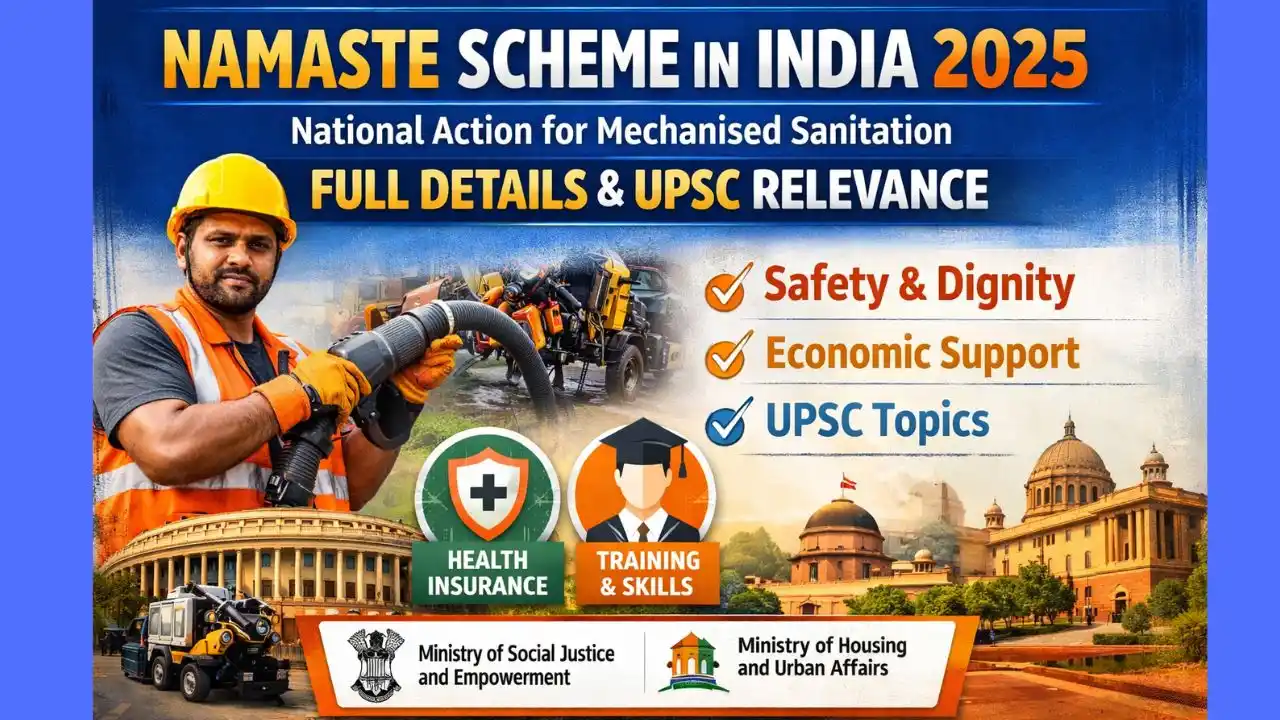
NAMASTE Scheme in India 2026: Full Details of Benefits, Objectives, and UPSC Relevance
India runs many welfare programs, but only a few directly confront life-threatening work conditions. The NAMASTE scheme is one of them. Launched to protect sanitation workers, it aims to replace hazardous manual cleaning with safe, mechanised systems and dignified livelihoods.
Let me explain what actually matters. NAMASTE is not a greeting. It is a policy commitment to protect human lives, end unsafe practices, and formalise one of the most neglected occupations in urban India. That is why it matters for governance, public health, and exams like UPSC.

What Is the NAMASTE Scheme?
NAMASTE stands for National Action for Mechanised Sanitation Ecosystem. It is a Central Sector Scheme of the Government of India, jointly implemented by the Ministry of Social Justice and Empowerment and the Ministry of Housing and Urban Affairs.
The objective is clear and uncompromising:
end hazardous manual cleaning of sewers and septic tanks and ensure sanitation workers get safety equipment, training, health insurance, and stable livelihood support.
The scheme replaces fragmented, older approaches and pushes sanitation work into a mechanised, regulated, and humane framework.
NAMASTE was launched in July 2023 with a planned implementation period up to 2025–26, covering urban local bodies across the country.
NAMASTE Scheme Full Form
NAMASTE = National Action for Mechanised Sanitation Ecosystem
The name signals a mindset shift. Sanitation work is no longer to be treated as invisible or informal. It is recognised as essential labour that deserves safety standards, skills, and dignity.
Why the NAMASTE Scheme Was Launched
Sewer and septic tank cleaning has long been among the most dangerous urban jobs in India. Workers often entered confined spaces without training or protective gear. Deaths from toxic gases and long-term health damage were common. Social stigma made matters worse.
NAMASTE was introduced to address these realities head-on. Its core aims are to:
- Stop deaths during sewer and septic tank cleaning
- Eliminate direct contact with human waste
- Promote mechanised sanitation technologies
- Train and certify sanitation workers
- Provide health insurance and financial support
This is both a human rights intervention and a public health reform.
Key Components of the NAMASTE Scheme
NAMASTE is not a single benefit. It is a structured ecosystem with multiple components working together.
1. Profiling and Registration
The scheme builds a verified national database of sewer and septic tank workers and waste pickers. Workers are surveyed, registered, and issued unique identities so they are formally recognised by the system.
2. Mechanisation and Safety Equipment
Manual entry into sewers is replaced with machines and specialised tools. Emergency Response Sanitation Units are equipped so that cleaning and rescue operations happen with mechanical support, not human bodies.
3. Personal Protective Equipment
Workers receive PPE kits such as gloves, boots, masks, and safety gear to reduce exposure to toxic substances and physical risk.
4. Training and Certification
Sanitation workers are trained in occupational safety and the use of mechanised tools. In some areas, digital and simulation-based training is also used. Skills gained are formal and transferable.
5. Health Insurance Coverage
Eligible workers are covered under Ayushman Bharat, ensuring access to hospital care without financial stress for them or their families.
6. Livelihood and Capital Support
Financial assistance and subsidies help workers purchase sanitation vehicles, equipment, or start sanitation-related enterprises. This supports income stability and entrepreneurship.
7. Inclusion of Waste Pickers
From 2024 onward, waste pickers were brought under the scheme. They receive safety gear, training, insurance, and pathways toward formal employment.
NAMASTE Scheme and UPSC Relevance
For civil services aspirants, NAMASTE is a high-value topic. It connects multiple syllabus areas:
- Social justice and welfare policy
- Urban governance and sanitation
- Labour reforms and occupational safety
- Public health administration
Points aspirants should remember:
- Implemented across all urban local bodies
- Runs through 2025–26
- Jointly managed by two central ministries
- Focuses on mechanisation and safety
- Covers sanitation workers and waste pickers
Questions may appear in prelims, mains, or essays, especially around objectives, implementation challenges, and social impact.
Benefits of the NAMASTE Scheme
The scheme delivers results beyond immediate safety.
1. Safety and Health
Mechanisation sharply reduces fatal risks. PPE and health insurance protect workers and their families from long-term harm.
2. Economic Stability
Capital support and enterprise opportunities allow workers to move from daily wage uncertainty to more predictable income.
3. Skill Development
Training converts experience into certified skills, opening doors to better roles and wages.
4. Formal Recognition
Registered workers gain official identity and access to government systems that were previously out of reach.
5. Social Inclusion
By addressing caste-linked occupational stigma and including waste pickers, the scheme promotes dignity and social equality.
Who Can Benefit From NAMASTE?
Direct Beneficiaries:
- Sewer and septic tank cleaners
- Waste pickers and recyclers
- Emergency sanitation response workers
- Sanitation workers employed by urban local bodies
Indirectly, cities benefit from safer sanitation systems and reduced public health risks.
NAMASTE Scheme Portal and Login Information
There is no public consumer-style login portal. Instead:
- Worker registration and monitoring happen through official MIS systems
- Urban local bodies and implementing agencies manage data entry
- Administrative dashboards are handled through designated government platforms
Workers seeking help should contact their municipal sanitation department or local implementing agency.
Role of State Governments
NAMASTE is a central scheme implemented nationwide. States and union territories execute it through urban local bodies.
State agencies conduct surveys, upload worker data, organise training, and distribute equipment while following central guidelines.
Challenges and the Road Ahead
Implementation is complex. Key challenges include:
- Identifying workers in informal or remote settings
- Ensuring consistent use of safety equipment
- Balancing mechanisation with employment security
Long-term success depends on monitoring, local leadership, and sustained political commitment.
– What is the NAMASTE Scheme in simple terms?
The NAMASTE Scheme is a government program that aims to stop dangerous manual cleaning of sewers and septic tanks. It replaces unsafe work with machines, safety gear, training, health insurance, and livelihood support for sanitation workers.
– When was the NAMASTE Scheme launched and till when will it run?
The scheme was launched in July 2023 and is planned to run until 2025–26. During this period, it is being implemented across urban local bodies throughout India.
– Who are the main beneficiaries of the NAMASTE Scheme?
The main beneficiaries are sewer and septic tank workers, sanitation workers in urban local bodies, emergency sanitation staff, and waste pickers who are now included under the scheme.
– Which ministries implement the NAMASTE Scheme?
The scheme is jointly implemented by the Ministry of Social Justice and Empowerment and the Ministry of Housing and Urban Affairs, making it a coordinated social welfare and urban governance initiative.
– Why is the NAMASTE Scheme important for UPSC and other exams?
NAMASTE is important because it covers social justice, labour welfare, urban sanitation, public health, and government reforms. Questions may focus on its objectives, components, implementation structure, and impact on vulnerable workers.
Conclusion
The NAMASTE scheme marks a turning point in India’s sanitation policy. It replaces risk with safety, invisibility with recognition, and neglect with structured support.
For workers who once risked their lives underground, it offers dignity and protection. For public administration, it sets a model for integrated, humane reform.
Also read:-