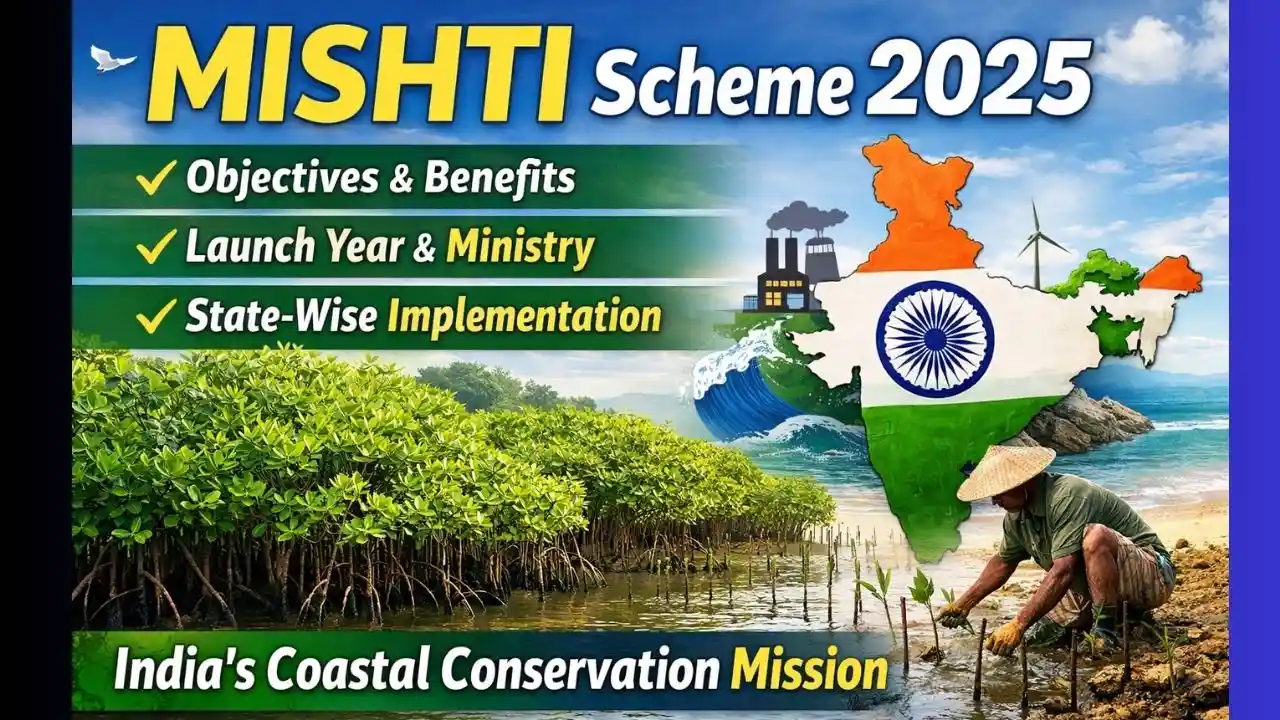
MISHTI Scheme 2026: Full Details, Objectives, Benefits, Launch Year, Ministry & State-wise Implementation
India’s coastline stretches over 7,500 kilometers. Along this vast edge lie some of the country’s most fragile ecosystems and some of its most vulnerable communities. Rising sea levels, stronger cyclones, and unchecked coastal development have put immense pressure on these regions. Against this backdrop, the MISHTI Scheme stands out as a focused, long-term response that treats environmental protection and economic security as inseparable goals.
Launched as part of India’s broader climate action framework, the MISHTI Scheme is not just about planting trees. It is about rebuilding natural coastal defenses, restoring livelihoods, and preparing India’s shoreline for a more uncertain future.
Here’s what matters. Let’s break down what the MISHTI Scheme 2026 is, why it exists, how it works, which ministry manages it, and why states like Gujarat are emerging as leaders in its implementation.
What Is the MISHTI Scheme 2026?
The MISHTI Scheme is a national initiative aimed at restoring, conserving, and expanding mangrove forests across India’s coastal regions and salt pan lands. Mangroves play a critical role in protecting coastlines, supporting marine life, and sustaining local economies. Yet, over decades, large tracts of mangroves were degraded or lost due to urban expansion, aquaculture, pollution, and climate stress.
MISHTI addresses this loss directly.
By 2026, the scheme is well into implementation and forms a core pillar of India’s coastal resilience strategy. Its objectives are clear and practical:
- Restore degraded mangrove ecosystems
- Increase India’s overall mangrove cover
- Improve coastal protection against erosion, cyclones, and storm surges
- Create sustainable income opportunities for coastal communities
- Integrate ecological restoration with local participation
This is not a short-term plantation drive. MISHTI is designed as a five-year program with monitoring, funding convergence, and community involvement built into its structure.
MISHTI Scheme Details
| Topic | Details |
|---|---|
| Scheme Name | MISHTI Scheme |
| Full Form | Mangrove Initiative for Shoreline Habitats & Tangible Incomes |
| Launch Year | 2023 |
| Active Period | 2023–24 to 2027–28 |
| Nodal Ministry | Ministry of Environment, Forest and Climate Change (MoEFCC) |
| Primary Objective | Restoration and expansion of mangrove forests |
| Key Focus Areas | Coastal regions and salt pan lands |
| Main Benefits | Coastal protection, climate resilience, biodiversity conservation, livelihood support |
| Target Ecosystem | Mangrove forests |
| Implementation Model | Converged approach using MGNREGS and CAMPA funds |
| Community Role | Plantation, conservation, nursery management, eco-tourism |
| Leading State | Gujarat |
| Major Achievement | ~19,000 hectares mangrove plantation in Gujarat |
| Livelihood Support | Employment, fisheries support, eco-tourism income |
| Climate Impact | Carbon sequestration and disaster risk reduction |
| National Importance | Supports India’s climate and coastal resilience goals |
Why Mangroves Matter More Than Ever
To understand MISHTI, you need to understand mangroves.
Mangroves are salt-tolerant forests that grow along coastlines, estuaries, and tidal areas. Their complex root systems trap sediment, reduce wave energy, and stabilize shorelines. During cyclones and tsunamis, mangrove belts can significantly reduce damage to inland areas.
But their value goes far beyond disaster protection.
Mangroves:
- Act as carbon sinks, storing more carbon per hectare than many terrestrial forests
- Serve as breeding grounds for fish, crabs, and shrimp
- Support fisheries, tourism, and small-scale coastal livelihoods
- Improve water quality by filtering pollutants
When mangroves disappear, coastlines erode faster, fisheries decline, and communities become more exposed to extreme weather. MISHTI is built on the recognition that protecting mangroves is not optional. It is essential.
MISHTI Scheme Full Form Explained
The full form of MISHTI is:
Mangrove Initiative for Shoreline Habitats & Tangible Incomes
Every word in this name reflects a deliberate policy choice.
- Mangrove Initiative: The scheme is ecosystem-specific, not generic afforestation.
- Shoreline Habitats: The focus is coastal and estuarine zones, where vulnerability is highest.
- Tangible Incomes: Livelihood creation is a central goal, not an afterthought.
MISHTI links conservation with income generation. Plantation work, nursery management, eco-tourism, fisheries support, and conservation monitoring all create paid opportunities for local communities. This alignment increases long-term success because people protect what also sustains them.
When Was the MISHTI Scheme Launched?
The MISHTI Scheme was announced in the Union Budget 2023–24, signaling strong political and fiscal backing. It was formally launched on June 5, 2023, World Environment Day, reinforcing its environmental focus.
The scheme runs from:
- Financial Year 2023–24 to 2027–28
This five-year timeline allows for:
- Baseline mapping of mangrove areas
- Phased plantation and restoration
- Monitoring of survival rates and ecosystem health
- Course correction based on scientific data
By 2025, MISHTI has moved beyond planning and pilot stages. Plantation targets are being executed, funds are being released, and early results are visible in multiple states.
MISHTI Scheme Comes Under Which Ministry?
The MISHTI Scheme is implemented under the Ministry of Environment, Forest and Climate Change (MoEFCC).
This ministry is responsible for:
- Forest conservation
- Biodiversity protection
- Climate change mitigation and adaptation
- Coastal regulation
Given the ecological importance of mangroves, MoEFCC is the natural nodal authority. However, MISHTI is not run by the central government alone.
Implementation involves:
- State Forest Departments
- Local governing bodies
- Research institutions
- Community organizations
This multi-level structure ensures that plantation decisions are informed by local geography, tidal patterns, and community needs rather than one-size-fits-all directives.
States Covered Under the MISHTI Scheme
MISHTI is active across India’s coastal belt and salt-affected lands. Key participating states and union territories include:
- Gujarat
- West Bengal
- Maharashtra
- Goa
- Karnataka
- Kerala
- Tamil Nadu
- Odisha
- Andhra Pradesh
- Andaman and Nicobar Islands
Each region has different mangrove species, tidal conditions, and land-use pressures. The scheme allows states to design location-specific action plans within a national framework.
Progress varies. Some states have moved faster in plantation and fund utilization, while others face administrative or technical delays. This variation highlights an important truth: policy success depends as much on state capacity as on central intent.
MISHTI Scheme in Gujarat: A Case Study of Scale
Gujarat offers one of the clearest examples of what MISHTI can achieve when implementation aligns with intent.
By the second year of the scheme, Gujarat had restored and planted mangroves across approximately 19,000 hectares, the highest among all states under MISHTI.
Several factors explain this performance.
1. Long and Diverse Coastline
Gujarat has a coastline of around 1,650 kilometers, covering the Gulf of Kutch, Gulf of Khambhat, and southern coastal zones. These regions are ecologically diverse and suitable for large-scale mangrove restoration.
2. Institutional Readiness
The state already had experience in coastal afforestation and marine conservation. MISHTI funding and structure accelerated ongoing efforts rather than starting from scratch.
3. Strong Coordination
State forest departments, local administrations, and community groups worked in coordination, ensuring faster land identification, nursery development, and plantation execution.
The result is not just increased tree cover. Mangrove expansion in Gujarat has strengthened fisheries, improved coastal biodiversity, and added a natural buffer against extreme weather events.
How the MISHTI Scheme Is Implemented
MISHTI is not funded or executed in isolation. It uses a convergence model, combining resources from multiple government programs.
Key supporting mechanisms include:
- MGNREGS: Provides wage employment for plantation and maintenance work
- CAMPA Funds: Support afforestation and forest restoration activities
- State Budget Allocations: Supplement central assistance
Implementation typically follows these steps:
- Identification of suitable sites based on tidal patterns and soil salinity
- Establishment of mangrove nurseries using native species
- Plantation and protection with community participation
- Monitoring of survival rates using satellite and field data
- Livelihood integration through eco-tourism, fisheries, and conservation roles
This layered approach reduces duplication, improves accountability, and ensures that mangrove restoration is maintained beyond the initial planting phase.
Community Participation and Livelihood Creation
One of MISHTI’s strongest design elements is its emphasis on local involvement.
Coastal communities are not treated as passive beneficiaries. They are active partners.
Through MISHTI, communities gain:
- Paid employment during plantation and maintenance
- Training in nursery management and conservation
- Opportunities in eco-tourism and guided coastal activities
- Improved fish stocks due to healthier mangrove ecosystems
This approach addresses a common failure of past conservation programs, where lack of local buy-in led to poor survival rates. MISHTI recognizes that long-term protection depends on economic relevance.
Why the MISHTI Scheme Matters for India
MISHTI operates at the intersection of environmental security and economic stability. Few schemes manage to balance both with such clarity.
Its benefits are tangible:
- Reduced coastal erosion and disaster damage
- Increased carbon sequestration
- Stronger fisheries and marine biodiversity
- More resilient coastal livelihoods
- Progress toward India’s climate commitments
Mangrove restoration is one of the most cost-effective climate adaptation strategies available. MISHTI scales this insight into national policy.
MISHTI Scheme and India’s Climate Commitments
India has committed to multiple international climate and biodiversity goals, including:
- The Paris Agreement
- Nationally Determined Contributions (NDCs)
- Coastal Regulation Zone protections
MISHTI directly supports these commitments by:
- Enhancing natural carbon sinks
- Reducing climate vulnerability in high-risk regions
- Strengthening ecosystem-based adaptation
In this sense, MISHTI is not just a domestic welfare scheme. It is a strategic component of India’s global environmental positioning.
Challenges and the Road Ahead
No large-scale initiative is without challenges.
MISHTI faces issues such as:
- Delays in fund utilization in some states
- Land ownership and encroachment disputes
- Species selection mismatches in certain regions
- Need for long-term monitoring beyond plantation
Addressing these challenges will determine whether early success translates into lasting impact.
MISHTI Scheme F.A.Q.
– What is the MISHTI Scheme 2026?
The MISHTI Scheme 2026 is a Government of India initiative focused on restoring and expanding mangrove forests along coastal and saline land areas. Its goal is to strengthen coastal protection, support biodiversity, and create sustainable livelihoods for coastal communities.
– What is the full form of MISHTI?
MISHTI stands for Mangrove Initiative for Shoreline Habitats & Tangible Incomes. The name reflects the scheme’s dual focus on environmental conservation and income generation for local communities.
– Which ministry implements the MISHTI Scheme?
The MISHTI Scheme is implemented by the Ministry of Environment, Forest and Climate Change (MoEFCC) in coordination with state forest departments and local agencies.
– When was the MISHTI Scheme launched and how long will it run?
The scheme was announced in the Union Budget 2023–24 and officially launched on June 5, 2023. It is a five-year program running from 2023–24 to 2027–28.
– Which state has shown the highest progress under the MISHTI Scheme?
Gujarat has emerged as a leading state under the MISHTI Scheme, with mangrove plantations covering around 19,000 hectares in the initial years, the highest among all participating states.
Conclusion
The MISHTI Scheme 2026 is not symbolic policy. It is practical, grounded, and measurable. It treats mangroves not as decorative greenery but as vital infrastructure. Healthy coastlines protect lives. They sustain economies. They buy time in a warming world.
MISHTI understands that reality. Its success will depend on steady governance, local trust, and sustained commitment. If those pieces hold, India’s coasts will be stronger for it.
Also read:-