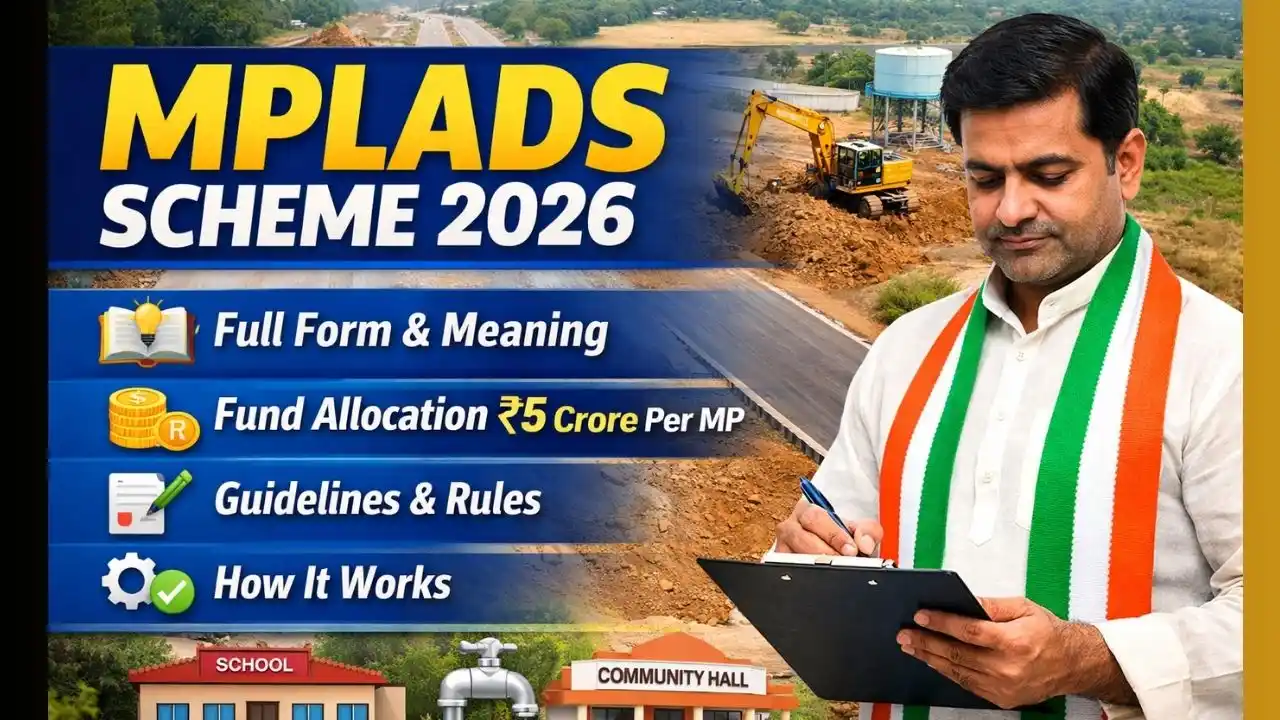
MPLADS Scheme Explained 2026: Meaning, Objectives, Fund Allocation, and Rules
The MPLADS Scheme remains one of India’s most debated government mechanisms for funding local development. It allows Members of Parliament to recommend infrastructure projects directly in their constituencies. The goal is straightforward: help MPs support the creation of assets that actually matter at the ground level, such as roads, drinking water facilities, schools, sanitation infrastructure, community halls, and similar public works.
As of 2026, the scheme continues under updated guidelines aimed at improving transparency and responsiveness to local needs. Digital systems and revised monitoring frameworks are reshaping how funds are released, tracked, and utilized. Here is what really matters.

What Is the MPLADS Scheme? Full Form and Meaning
MPLADS stands for Members of Parliament Local Area Development Scheme. It is a Central Sector Scheme, fully financed by the Government of India. The intent is not to expand the authority of MPs, but to give them a structured way to recommend development works based on local priorities.
These recommendations must focus on creating durable community assets. The emphasis is on projects that deliver long-term public value. Typical examples include water supply systems, primary schools, public toilets, approach roads, and drainage networks that support daily life.
What makes MPLADS different is its direct connection to local realities. Funds do not pass through multiple layers of political approval. MPs recommend works, and district authorities are responsible for scrutiny, approval, and execution through approved agencies.
Because of this structure, the scheme is frequently discussed in competitive exams as an example of decentralized development and the real challenges of linking policy with local implementation.
MPLADS Scheme Details
| Aspect | Details |
|---|---|
| Scheme Name | Members of Parliament Local Area Development Scheme |
| Abbreviation | MPLADS |
| Launch Date | 23 December 1993 |
| Type of Scheme | Central Sector Scheme |
| Implementing Ministry | Ministry of Statistics and Programme Implementation |
| Annual Fund per MP | ₹5 crore |
| Nature of Fund | Non lapsable |
| Purpose | Creation of durable community assets |
| Who Recommends Works | Members of Parliament |
| Who Executes Works | District Authorities through implementing agencies |
| Fund Release Mode | Grants in aid to district authorities |
| Priority Allocation | Minimum 15% for SC areas and 7.5% for ST areas |
| Allowed Works | Roads, schools, water supply, sanitation, community infrastructure |
| Not Allowed | Personal benefit works, land acquisition, religious structures |
| Monitoring | District authorities and digital tracking systems |
| Relevance for Exams | Governance, decentralization, public finance, UPSC |
MPLADS Scheme Launch Date and Background
The MPLADS Scheme was launched on December 23, 1993. It was introduced to address development gaps that often remain even after state and central schemes are implemented. From the beginning, the focus was on building tangible public assets that improve local infrastructure and community life.
At launch, the annual allocation was modest at only ₹5 lakh per MP. Over time, as expectations grew and costs increased, the allocation was revised upward multiple times.
Administrative responsibility for the scheme was transferred in 1994 from the Ministry of Rural Development to the Ministry of Statistics and Programme Implementation. Since then, this ministry has handled policy decisions, fund releases, and operational guidelines.
How MPLADS Works in 2026: Funds and Implementation
Under MPLADS, the central government allocates a fixed annual amount to each Member of Parliament for development works in their constituency.
Annual Fund Allocation
From the 2011–12 financial year onward, each MP has been entitled to ₹5 crore per year. This amount is non lapsable. If funds are not used in a particular year, they carry forward to the next.
In recent parliamentary discussions, proposals have been raised to increase this annual allocation to ₹10 crore. These discussions reflect rising development demands and inflation, although any change depends on budgetary approvals and legislative decisions.
How the Funding Cycle Operates
Funds are not given directly to MPs. Instead, they are released as grants in aid to district authorities. The process works as follows:
MPs recommend eligible development works
District authorities examine proposals and sanction approved projects
Implementing agencies are selected, usually government departments or local bodies
Execution and monitoring are carried out at the district level
Funds are generally released in two instalments each year, subject to utilization and compliance.
Priority Areas and Inclusion
The scheme mandates that at least 15 percent of funds must be spent in areas predominantly inhabited by Scheduled Castes, and 7.5 percent in Scheduled Tribe areas. This provision ensures that development reaches communities that have historically faced infrastructure gaps.
MPLADS Scheme: Administrative Ministry
The MPLADS Scheme is administered by the Ministry of Statistics and Programme Implementation. It has served as the nodal ministry since October 1994.
The ministry frames guidelines, releases funds based on utilization reports, and coordinates with states. State level nodal departments and district authorities manage on ground implementation, supervision, and reporting.
MPLADS and UPSC: Why the Scheme Matters
For civil service examinations, MPLADS is an important example of a Central Sector Scheme connected to governance, decentralization, and development administration.
Aspirants should clearly understand:
The objective of creating durable local assets
The administrative chain from the central ministry to district authorities
The fund release and monitoring mechanism
The inclusion mandate for Scheduled Caste and Scheduled Tribe areas
Common challenges such as delays, misuse, and accountability gaps
Questions often test how such schemes balance national funding with local execution, or what reforms could improve their effectiveness.
Digital Systems and Technology Integration
In recent years, the functioning of MPLADS has been strengthened through digital platforms.
Fund Tracking and Monitoring Systems
Dedicated digital portals and applications now track the entire project lifecycle, starting from recommendation and sanction to execution and completion. These systems aim to:
Increase transparency
Enable real time monitoring
Improve recordkeeping and fund flow efficiency
Officials across states and implementing agencies receive training to operate these systems under revised procedures.
Login and Access Structure
These portals are not open to the general public. Access is limited to authorized users such as district authorities, implementing agencies, state nodal officers, and MPs. Each user receives secure login credentials to upload project details, expenditure data, and compliance reports.
The core objective is accountability at every stage, including recommendation, approval, execution, and reporting.
Permitted Works and Restrictions Under MPLADS
MPLADS allows funding for a wide range of public development activities, but strict rules apply.
Works That Are Allowed
Construction of community infrastructure such as schools, halls, and roads
Drinking water supply projects
Sanitation and public hygiene facilities
Public transport shelters
Veterinary centers and sports infrastructure
Drainage and water management works
Works That Are Not Allowed
Routine maintenance or repair of existing assets
Purchase or acquisition of land
Compensation payments
Projects meant for individual or personal benefit
Religious structures, memorials, or private institutions
District authorities are required to verify compliance before approving any project.
Challenges and Policy Debates
Like many public schemes, MPLADS has faced criticism over the years. Common concerns include poorly assessed local needs, delays in execution, incomplete projects, and weak monitoring.
These issues continue to drive policy debates. Discussions around increasing the annual allocation and strengthening digital monitoring tools show efforts to modernize the scheme while improving accountability.
MPLADS Scheme F.A.Q.
– What is the MPLADS Scheme?
The MPLADS Scheme is a Central Sector Scheme that allows Members of Parliament to recommend local development projects in their constituencies. The focus is on creating durable public assets such as roads, schools, water supply systems, sanitation facilities, and community infrastructure.
– How much fund does an MP get under MPLADS?
Each Member of Parliament is entitled to ₹5 crore per year under the MPLADS Scheme. The fund is non lapsable, which means unused amounts are carried forward to the next financial year.
– Which ministry implements the MPLADS Scheme?
The MPLADS Scheme is implemented by the Ministry of Statistics and Programme Implementation. The ministry releases funds, issues guidelines, and coordinates with state and district authorities for execution and monitoring.
– Can MPLADS funds be used for personal or private projects?
No. MPLADS funds cannot be used for personal benefit, private institutions, religious structures, land acquisition, or routine maintenance work. Only public and community focused development projects are allowed.
– Why is the MPLADS Scheme important for UPSC and other exams?
MPLADS is frequently asked in competitive exams because it shows how central funds are linked to local development. It covers themes like decentralization, governance, accountability, and public policy implementation, which are core areas in civil service exams.
Conclusion: MPLADS Scheme in 2026
The MPLADS Scheme remains a significant instrument for grassroots development. It connects national funding with local action by allowing MPs to recommend community focused infrastructure projects based on real needs.
In 2026, the scheme operates with a ₹5 crore annual allocation per MP, relies on digital platforms for monitoring, and functions under the Ministry of Statistics and Programme Implementation. For policymakers, governance students, and civil service aspirants, understanding MPLADS explains how development funds move from central allocation to village roads, water systems, and public facilities.
Also read:-