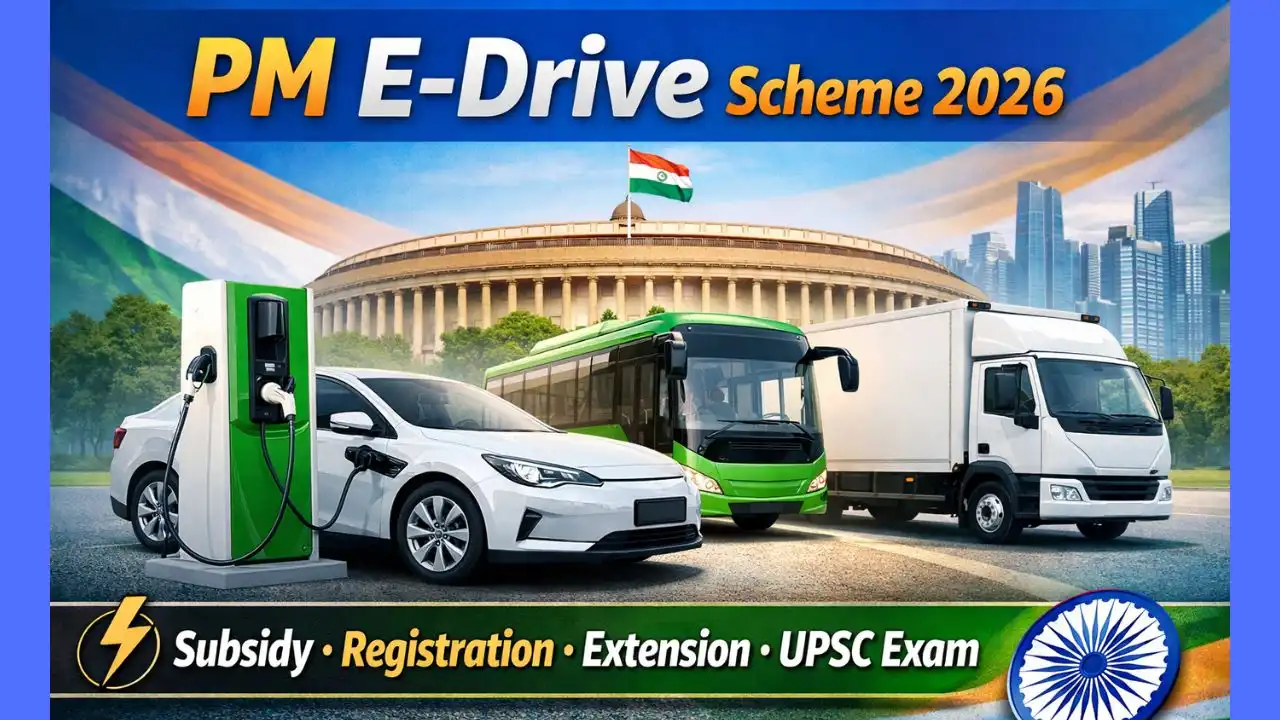
PM E-Drive Scheme 2026: Full Details on Subsidy, Registration, Extension, and UPSC Relevance
India’s shift toward electric mobility is no longer theoretical. It’s visible on city streets, reflected in public spending, and shaping how people think about transport choices. One of the key drivers of this transition is the PM E-Drive Scheme, a major initiative by the Government of India aimed at accelerating electric vehicle adoption, expanding charging infrastructure, and reducing pollution caused by conventional fuel-based vehicles.
This article explains what the PM E-Drive Scheme is, why it was introduced, how it functions, details of its extension, the registration process, subsidy structure, its importance for UPSC and other civil services exams, and its status as India moves closer to 2026.
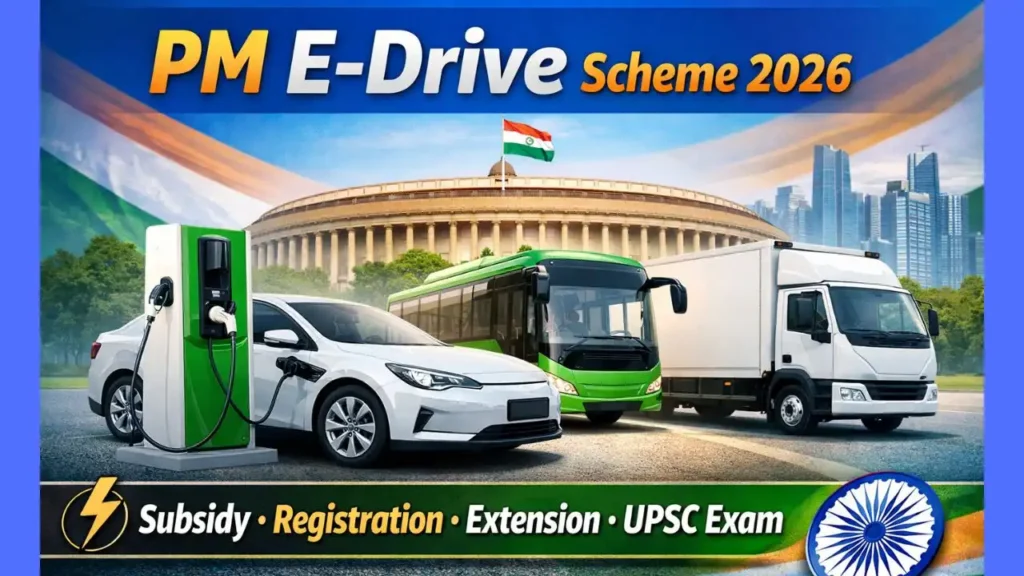
What is the PM E-Drive Scheme?
PM E-Drive stands for Pradhan Mantri Electric Drive Revolution in Innovative Vehicle Enhancement. The scheme is a centrally sponsored programme designed to reduce the initial cost of electric vehicles while simultaneously building the infrastructure and industrial ecosystem needed to support large-scale EV adoption in India.
Here’s what matters most:
- The scheme combines demand incentives for EV buyers with financial support for public charging infrastructure and key components of the EV supply chain.
- It covers a wide range of vehicle categories, including electric two-wheelers, three-wheelers, buses, trucks, and ambulances.
- Dedicated funds are allocated for testing, certification, and quality assurance facilities to ensure safety standards keep pace with rapid growth.
- The total financial outlay is ₹10,900 crore, making it one of the most ambitious electric mobility programmes India has launched so far.
PM E-Drive is not just about subsidies. It fits into India’s broader goals of reducing carbon emissions, cutting dependence on imported fossil fuels, boosting domestic manufacturing under the Make in India initiative, and moving toward long-term net-zero targets.
PM E-Drive Scheme Details
| Aspect | Details |
|---|---|
| Scheme Name | PM E-Drive Scheme |
| Full Form | Pradhan Mantri Electric Drive Revolution in Innovative Vehicle Enhancement |
| Launch Date | October 1, 2024 |
| Nodal Ministry | Ministry of Heavy Industries |
| Total Outlay | ₹10,900 crore |
| Objective | Promote electric vehicle adoption, reduce emissions, expand charging infrastructure |
| Covered Vehicles | Electric two-wheelers, three-wheelers, buses, trucks, ambulances |
| Subsidy Method | Demand incentive via Aadhaar-based e-voucher |
| Subsidy Cap (2W & 3W) | Up to 15% of ex-factory price |
| Scheme Validity | 2W & 3W: till March 31, 2026 |
| Extended Validity | Buses, trucks, ambulances, charging infra: till March 31, 2028 |
| Registration Mode | Online through official PM E-Drive portal |
| Exam Relevance | UPSC, State PCS, SSC, Policy & Environment studies |
When Was the PM E-Drive Scheme Launched?
The PM E-Drive Scheme was officially notified in September 2024 and became operational from October 1, 2024.
It builds on earlier electric mobility initiatives such as the FAME (Faster Adoption and Manufacturing of Electric Vehicles) Phase I and II and the Electric Mobility Promotion Scheme (EMPS-2024). The intent was to introduce a more focused, better-funded, and outcome-driven framework with clearer targets.
A major reason for the timing of the launch was the realization that EV adoption depends not only on vehicle incentives but also on charging infrastructure and policy certainty. The scheme aimed to align manufacturers, buyers, and infrastructure providers under a single, coordinated push.
Which Ministry Administers the PM E-Drive Scheme?
The PM E-Drive Scheme is implemented by the Ministry of Heavy Industries (MHI).
Since the ministry oversees industrial development and manufacturing policy, it acts as the nodal authority for EV-related incentives, infrastructure grants, and guidelines. The Ministry of Heavy Industries periodically issues notifications detailing eligibility conditions, e-voucher procedures, subsidy disbursal mechanisms, and infrastructure support norms.
PM E-Drive Scheme and UPSC / Civil Services Preparation
For UPSC and other competitive exams, PM E-Drive is highly relevant under multiple syllabus areas, including current affairs, economic development, infrastructure, environmental policy, and sustainable growth.
Key points aspirants should focus on:
- The core objective of accelerating EV adoption and reducing transport-related emissions
- Its alignment with national goals such as Aatmanirbhar Bharat and India’s net-zero target for 2070
- The institutional framework, with the Ministry of Heavy Industries as the nodal agency
- How the scheme replaces or builds upon earlier programmes like FAME and EMPS
- The importance of policy extensions and mid-course corrections based on implementation feedback
Understanding these aspects helps in writing answers that link policy intent with on-ground execution, something UPSC examiners consistently value.
How to Register for the PM E-Drive Scheme Online
The PM E-Drive incentives are accessed through an official online portal managed by the government. The registration and subsidy flow works as follows:
- Vehicle Selection
Choose an eligible electric vehicle category such as a two-wheeler, three-wheeler, bus, truck, or ambulance. - Online Application
Apply through the PM E-Drive portal by entering personal and vehicle details. Aadhaar authentication is used to generate an e-voucher. - Document Submission
The e-voucher is submitted to the dealer at the time of purchase. - Dealer Verification
The dealer uploads the signed voucher and sale details on the portal. - Subsidy Claim
The vehicle manufacturer (OEM) claims reimbursement from the government based on verified vouchers.
This digital, e-voucher-based system is designed to reduce delays, prevent misuse, and ensure transparency in subsidy disbursement.
It’s important to note that incentives for certain vehicle segments, particularly smaller EVs, are time-bound.
PM E-Drive Scheme Full Form
The full form of PM E-Drive is:
Pradhan Mantri Electric Drive Revolution in Innovative Vehicle Enhancement Scheme
The name reflects the scheme’s twin focus on accelerating electric mobility and promoting innovation across vehicle technology and infrastructure.
PM E-Drive Scheme: Extended Till When?
Originally, the PM E-Drive Scheme was scheduled to run until March 31, 2026.
In August 2025, the government approved a two-year extension, taking the scheme up to March 31, 2028, but with specific conditions.
Here’s the nuance:
- Subsidies for electric two-wheelers, three-wheelers, e-rickshaws, and e-carts continue only until March 31, 2026.
- Support for larger vehicles such as electric buses, trucks, ambulances, and charging infrastructure has been extended until March 31, 2028, or until the allocated ₹10,900 crore budget is fully utilized.
This staggered extension reflects where adoption has been faster and where longer timelines are needed to achieve meaningful scale.
PM E-Drive Scheme Subsidy Details
The subsidy under PM E-Drive is structured as a demand incentive rather than a flat discount. It is linked to battery capacity, vehicle category, and price limits.
Broadly:
- For electric two-wheelers and three-wheelers, incentives are capped at around 15 percent of the ex-factory price.
- In FY 2024–25, the subsidy rate was approximately ₹5,000 per kWh of battery capacity.
- In FY 2025–26, this rate was reduced to around ₹2,500 per kWh.
- For larger vehicles such as electric buses, trucks, and ambulances, the scheme sets aside fixed budget allocations, including dedicated funds for e-ambulances and e-trucks.
Since subsidy rates and eligibility conditions can change by financial year, buyers are advised to check the latest official notifications before making a purchase decision.
PM E-Drive Scheme F.A.Q.
– What is the main objective of the PM E-Drive Scheme?
The primary goal of the PM E-Drive Scheme is to accelerate the adoption of electric vehicles in India by reducing upfront costs, expanding charging infrastructure, and supporting domestic EV manufacturing, while also cutting emissions from fossil-fuel vehicles.
– Which types of vehicles are covered under the PM E-Drive Scheme?
The scheme covers electric two-wheelers, three-wheelers, buses, trucks, and ambulances. Support is also provided for public charging infrastructure and testing and certification facilities.
– Is the PM E-Drive Scheme applicable across India?
Yes, the PM E-Drive Scheme is a nationwide programme and is applicable in all states and union territories, subject to vehicle eligibility and availability of allocated funds.
– How long are subsidies available under the PM E-Drive Scheme?
Subsidies for electric two-wheelers and three-wheelers are available until March 31, 2026. Incentives for larger vehicles and charging infrastructure have been extended until March 31, 2028, or until the scheme’s budget is exhausted.
– Do buyers receive the subsidy directly in their bank account?
No. The subsidy is applied through an e-voucher system at the time of purchase. The manufacturer claims reimbursement from the government after verification, which lowers the effective purchase price for the buyer.
Conclusion
The PM E-Drive Scheme represents a major step in India’s journey toward cleaner, more sustainable transport. It goes beyond short-term incentives and focuses on building long-term capacity through infrastructure development, industrial growth, and technology adoption.
The extension of support until 2028 for heavy vehicles and charging infrastructure gives the programme the time it needs to deliver deeper, structural impact. For consumers, the incentives though time-bound can significantly reduce upfront costs. For students, policymakers, and analysts, PM E-Drive offers a clear example of how environmental goals, economic strategy, and implementation realities intersect in public policy.
Also read:-